Featured Post

Lotus 7 Adventure begins

In the fall of 2019 I found the 1984 Super Seven Sports Car company Lotus 7 S3 at Sodo-Moto in Seattle Washington. After negotiation and...

Monday, March 30, 2020

air filter assembly

Air Filter Assembly

-  the engine started with 75MM velocity stacks with SS screens only.  These are rather restrictive and do no filtering.  The particle size on the screens is 140 micros while typical dust is 20 to 30 microns.  So there is little to no filtration of dust, bugs or rain.


While this may look cool it is not very effective and keeping the dirt out of the engine.  The chokes were wide open to the atmosphere.  

I went with ITG Sausage filter from Daemon-Tweeks with an aluminum blank mounting plate.


Step 1 was to cut down the velocity stacks from 75mm to 47mm.  cut holes for the throttle bodies, chokes and velocity stack mounts.  This left very little room for the filter to fit.   After trial and error the only way to fit was to install the 3rd velocity stack (from the firewall) first.  Then insert the stack for the front cylinder and mount it.  This was followed by the rear two velocity stacks.   


The completed project provides filtration and quietened the intake sounds slightly.  


Lexan Doors

Lexan Doors

After advice from the Internet and Industrial Plastics, I went with 3mm  M10 - Lexan.  This is the version with the Antiscratch coating.

-  I removed the metal frame from the original doors. and attached a cardboard cutout of the door.  This allowed for adjustments and tight fit to the new door opening.

Once I was happy with the fit I used the cardboard as a template to transfer to the Lexan sheet.

The next step was to cut the Lexan.  I choose to use the scroll saw for this and while it did do the job with the new plastics blade is was difficult to control and shape the corners.  For the second door, I used the Bosch Jigsaw with the Plastics blade.

This made for very easy and controlled cuts, corners and shaping.  The edges were cleaned up on the belt sander.  the final edge sanding was done with a hand file and 400grit paper.

I next attached the metal frame from the original door to the Lexan.  All holes were drilled with cobalt drill bits and a slow and steady drill made perfect holes.

Blind nuts were used to connect the two together.  A strap with snap for a door latch and I was on the road.


The added length of the door eliminates the buffeting from the sides.  Even at highway speeds, the buffeting is negligible. 

To test this I removed the doors and went for a blat around the block onto the highway. I got up to 60 MPH and the wind and vortex tried to suck the toque right off my head.  This is the standard effect of a doorless 7 on the highway.  

Test 2 was to put the wind wings on and go for another loop.  While this was better and my hat stayed on my head is was less than comfortable at speed.

The final test was with the doors for the same loop.  Wow, what a difference.  Virtually eliminated the buffeting and I was able to have a conversation with the passenger.  


provincial inspection

Inspection at Ian Tait Mechanical

- Professional service at a reasonable price

- minor repair to a headlight and i was on my way with an inspection sticker


Sunday, February 2, 2020

hoods up

1st pass at the hood aka roof was done today. 

Made aluminum support bars.  Some tweeking and quick connects still need to be sorted.  Edge repair and new windows in the next couple weeks and then make frameless lexan doors.  


Feb 18 - Change in plans,   Windows were polished with Maguires Plastex polish and turned out clear enough for use.

Top is off to have doors widened by 6 inches and door edges re-stitched . This should eliminate or reduce the drivers blind spots.  


Wednesday, January 22, 2020

Performance Documentation


Performance Upgrades from stock listed in the graphic at the bottom
- Weight 1250 LBS
- GVWR 1345 LBS

- Engine
- Toyota 2TG with 3TG Crank for 1940CC @  6000RPM with  9.8:1 Compression Approx 162 to 165 HP 
- This is a twin cam with 8 valves with a chain drive DOHC  
- Head # 11111-88220


Head #:11111-88222
Head:Second 2T-G(R), alloy inspection plate
Cam Cover:no "1600" -space used for vacuum solenoid, "Toyota" on left. Steel gold oil cap on left. Wrinckle black.
Camshafts:256 degrees duration, 10.27mm lift
Valves:44.5mm intake, 38.5mm exhaust
Pistons:8.8:1 (88224)
Fuel:Solex Mikuni 40mm sidedrafts, adjustable fuel levels
Power:115-125ps ( Stock at 1600cc) @ 6400rpm
Torque:
Bore x stroke:85mm x 70mm = 1588cc
Aplication:TA22 Celica GT/GTV, TA27 Celica GT, TE27 Levin/ Trueno, TE37 Levin, TE47 Trueno GT
Dates:April 1973 to Nov. 1976
other:8mm exhaust studs


- Mikuni 44 Carbs
- MSD 6AL Ignition, MSD Blaster 2 Coil, MSD Digital Points, MSD Cap and Wires
- Header, resonator and Flowmaster HP2 SS muffler

Trans
- 5speed manufacturer numbers 110 18551

Axle
- Toyota Live axle with LSD.  unable to find the marking yet.  However, the best guess so far is T283
T= 6.7" crown and pinion,  28 = 4.3 ratio and 3 = 2 Spider LSD

Tires
-  Front Yokohama A048 185/60/13 on 6" Watanabe Rims
- Rear Yokohama A048 205/60/13 on 7" Watanabe Rims

Performace
- Estimate 0 - 60 in 5 sec range (to be verified with DragRacer and GPS SPeedo App in March


wipers

Sunday, January 19, 2020

Manufactured by Super Seven Sports Cars

History -
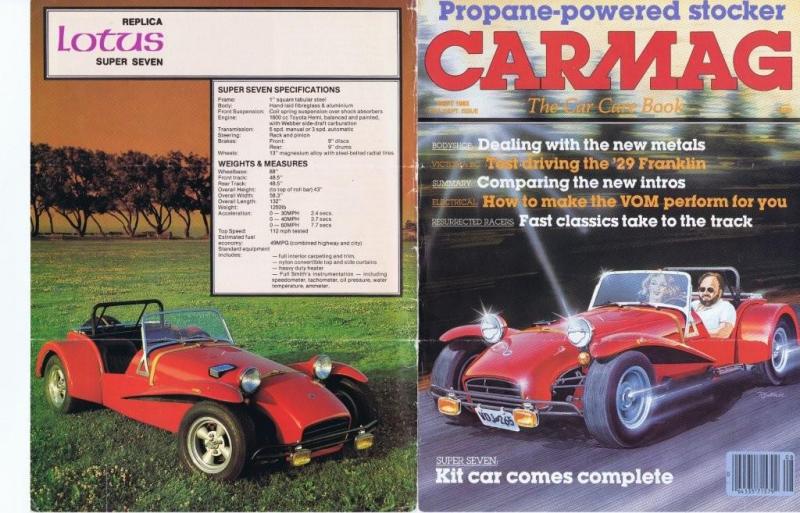
This super seven was manufactured in Ontario in 1984.  It was shipped as a left driven to the Japanese market.  Over time the motor was stroked to 2ltr, mikuni 44 PHH carbs and authentic Watanabe Wheels were added.  The car had approx 16500km when I purchased.

Here are a few articles on the history of Super Seven Sports Cars.  They started off with the Fejer brothers building and competing in Can-Am racing in the 60-70's with the Chinook Cars.  They started building super 7's in Ontario and became an federally approved manufacturer in the early 80's.  They built 7's for Canada and Japan market.  The various articles indicate 1 order for 100 cars to Japan with a potential follow up order for 200 more cars.   The company had financial issues and founding owner George fejer had health issues.  Over the next few year the company changed names several times.

So far I have found Mark Seven Co,  Canadian sports cars and Super Seven Sports Cars Ltd. 

The super Seven Sports Car Company went out of business and morphed into MCC where the design continued. 


Orignially they had 1600cc Toyota 2TG power and running gear from 1970 to 1973 celica.

Currently this one has 2000CC 2TG power.  A fresh rebuild to this spec is estimated at 162 to 165 with carbs and 9.8:1 compression.  F3 Fuel injected version with restrictir intake was 170 to 180hp depending on the restrictor.   Peak F3 racing HP was 198 with 12.5:1 compression.  The full factory race 1600cc version was 240hp and the factory ralley version made 330hp normally asperated.  


Super Seven Sports Car Company - Fejer Brothers from Ontario Canada.